Skip to content
Primary Menu

Home Research Research

Research


Our graduate and undergraduate students collaborate with faculty and staff on research in all fields of chemistry. The very first PhD earned at the University of Utah was in chemistry, by Dr. James M. Sugihara in 1947. Since then, we have awarded doctorate degrees to more than 1,100 students. Today, the Department of Chemistry is one of the U's major research hubs and the largest PhD-granting department on campus. Scientists at the University of Utah benefit from the impressive history of the department and the tradition of excellence our students and faculty have built over the past 67 years.

Explore our state-of-the-art facilities, laboratories and specialized shops where groundbreaking research comes to life.

Facilities & shops

Partnership & Collaborations


Research is often undertaken in partnership with other groups in the department, other departments on campus and at other universities around the country and around the world. The department’s annual research expenditures total more than $10 million and include grants from federal agencies such as the National Science Foundation (NSF) and National Institutes of Health (NIH), among others.

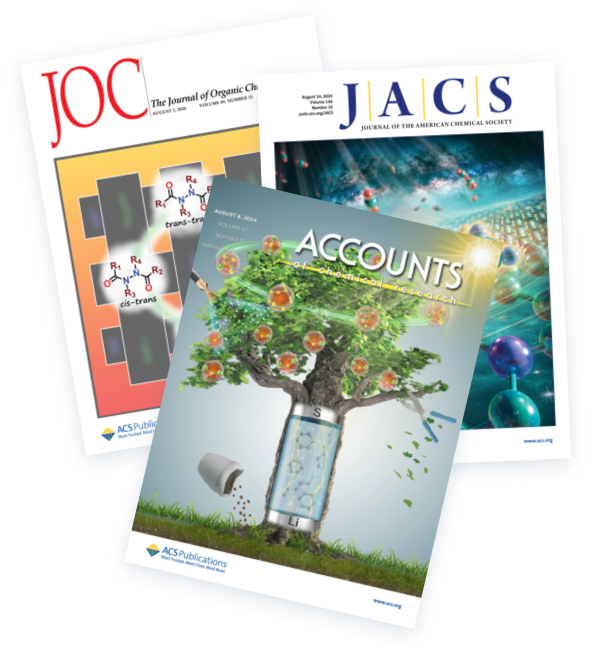
The department is also the home of the editors of the Journal of the American Chemical SocietyJournal of Organic Chemistry and Accounts of Chemical Research.

Research Experiences for Undergraduates - REU Program


Join undergraduates from colleges and universities across the United States. Engage in full-time, cutting-edge research on a project of your choice. REU participants will be fully integrated in our faculty’s research groups, which address various challenging problems in energy, health, environment, and education.  This REU program will also emphasize the development of data analysis and modeling skills that are broadly applicable to modern chemistry research.

Chemistry Journal Magazine Covers
Henry Eyring Center for Theoretical Chemistry

Housed in the Thatcher Building, the Henry Eyring Center for Theoretical Chemistry applies modern theoretical and computational techniques to address problems in chemical physics, materials chemistry, polymer science, medicinal and biological chemistry and biophysics.

Learn More
Center for Cell and Genome Science

The Center for Cell and Genome Science (CCGS) provides a dynamic, interdisciplinary environment for development and pursuit of strategies to visualize, probe and manipulate the microscopic workings of cells.

Learn More
Center for Advanced Microscopy

The Center for Advanced Microscopy provides advanced technologies to the biosciences community at the University of Utah and to develop new technologies that will drive novel research in the future.

Learn More
Center for Science and Math Education

The Center for Science and Mathematics Education (CSME) empowers students to succeed in math and science by enhancing the quality of K-12 instruction and promoting the academic success and career readiness of undergraduate students at the University of Utah.

Learn More

Credit-based Research Q&A (CHEM 4800/4801)

CHEM 4800/4801 does not place students in a research lab but rather gives them credit towards their degree for the research they are already doing. This course can only be utilized by students declared in the chemistry or biochemistry bachelors degree or the chemistry minor.
  • Registering for CHEM 4800 requires approval from a chemistry advisor before hand. Below is the link to the form you will need to fill out. A chemistry advisor will reach out to you when your request is processed, normally within 5 business days. The chemistry advisor will email you at your student email with the permission code if approved or they will reach out to gather more information to get you approved.

    The chemistry advising team is not responsible for finding you a research lab, please already be in one at the time of filling out the request. The chemistry department will not give credit towards clinical labs. The lab has to be chemistry or biochemistry related. Labs will be determined as acceptable at the discretion of the chemistry department.

    CHEM 4800/4801 Form: https://forms.gle/XRz3gJgukcDcYHLE8


    • A great place to start is the research page on the Chemistry Department website. U of U faculty are grouped by their area of research; many faculty have links to their research and publications.  
    • Another great place to look is the Office of Undergraduate Research. You can search for internships in the OUR database. 
    • Once you find something that interests you, reach out to the faculty member in a professional email. Be sure to introduce yourself and provide what courses and labs you’ve completed. Explain why you’re interested in the professor’s research and ask if they have any openings in their lab. 
    • You may need to reach out to several faculty to find someone who has an opening in their lab.  
  • NoYou need to submit the form (see here) and register for CHEM 4800/4801 just like you would for a class  

    • No. You must apply for research credit for a future or current semester. 
    • Please apply before the start of each semester. The last day to add classes is the second Friday of each semester.  


    • For chemistry, research fulfills one or two credits of elective credit.  
    • For biochemistry, research fulfills one advanced lab course. 
    • Research fulfills only one credit for the chemistry minor.  
    • Please run a Degree Audit to confirm what research will fulfill for your major. 
    • You can apply up six total credits of research towards your degree. The ratio is 1 credit per 5 hrs a week of lab work.
    • You can use a maximum of two research credits to count for your major. You cannot use multiple semesters of research to fulfill lab or elective credit. Anything above two credits goes towards your total 120 total credits.  
    • Yes. Non-honors research is CHEM 4800. Honors research is CHEM 4801. 
    • Note, you cannot count both CHEM 4801 and CHEM 4999—honors thesis toward your major requirements.
  • The professor you are working for will provide you with a grade at the end of the semester.